
Switchback
A reversing trail turn that trades a direct climb for a longer, more stable route.
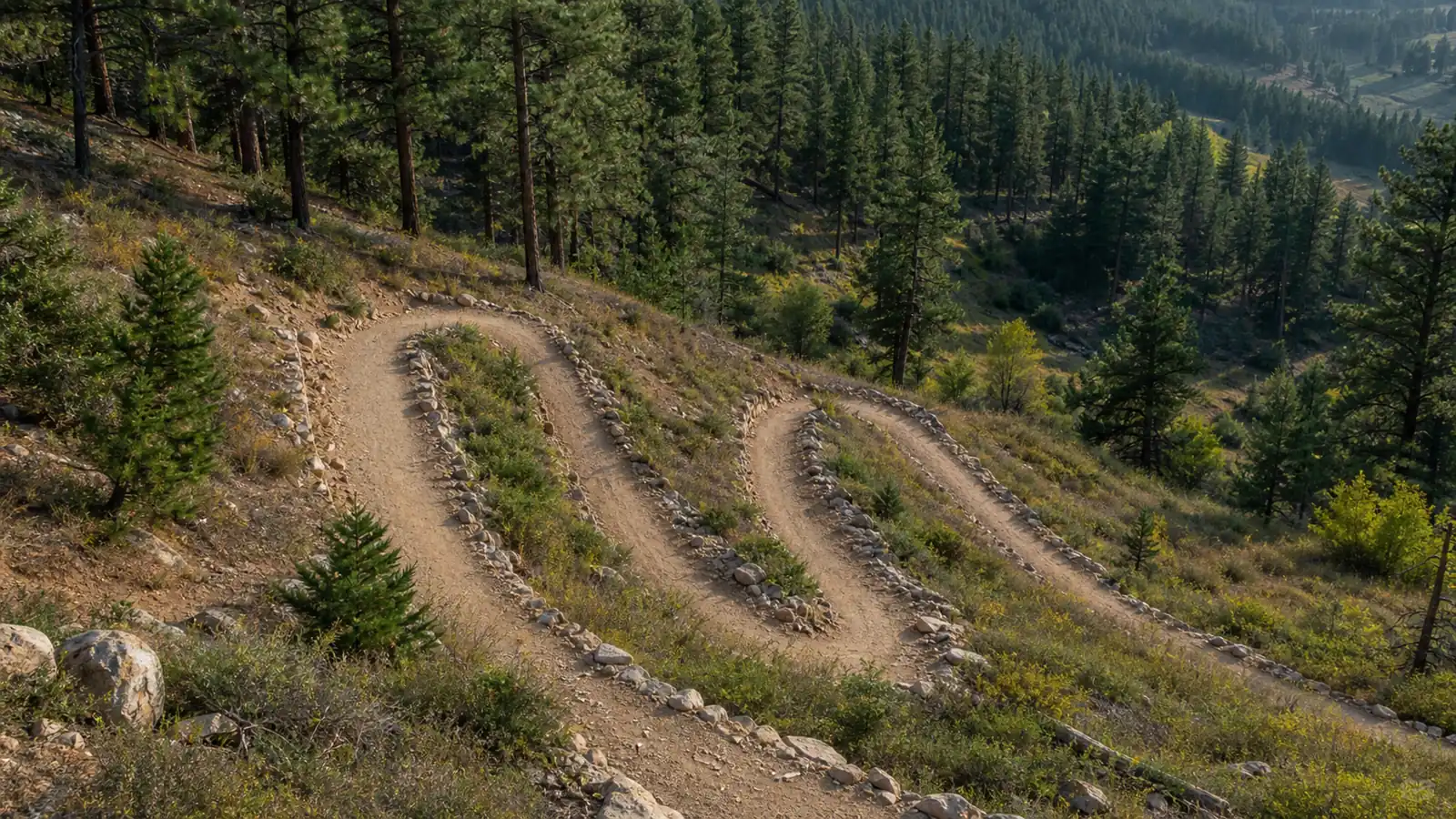
A switchback carries a trail back across a slope to manage grade, drainage, footing, and erosion. Stay on the constructed tread through the full turn because a short cut creates a steeper scar that channels water and damages the slope.
What is a switchback on a trail?
A switchback is a constructed turn where a trail reverses direction across a slope. Several turns let the route gain or lose elevation over more distance instead of climbing straight up the fall line.
The word can describe one reversal or a longer series of zig-zagging traverses. The built feature includes the approach, the turning platform or curve, drainage work, supporting soil or rock, and the outgoing tread.
It is more than the sharp corner visible on a map.
The turn manages the whole slope, not only your walking comfort.
- Shape
- A reversal connected by traverses across a slope
- Purpose
- Manage grade, footing, drainage, erosion, and sustainable access
- Built tread
- Approach, turn, drainage, support, and outgoing trail work together
- Hiker action
- Follow the full established tread through every turn
- Main damage
- Short cuts create steep parallel scars that collect water and loosen soil
A switchback differs from a bend that follows a stream or avoids an obstacle. The defining feature is the reversal used to move across steep terrain.
Why are switchbacks longer than a direct climb?
Distance gives the trail room to spread elevation change. A direct line may look efficient on a map, yet it can produce a grade that is difficult to walk and hard to drain.
Water moving down that line gains speed and carries soil with it.
Cross-slope traverses reduce that direct fall-line effect. Trail crews can place drains, reinforce turns, and choose more durable ground.
Hikers gain a steadier rhythm and a route that is easier to maintain.
Extra distance protects the tread and usually saves energy over the full climb.
| Route choice | Walking effect | Trail effect |
|---|---|---|
| Constructed switchback | Longer distance with repeated turns | Spreads grade and directs water through planned drainage |
| Fall-line path | Short, steep climb or descent | Water accelerates down the same line as travel |
| Corner shortcut | Brief distance saving | Creates a parallel scar between trail levels |
| Widened turn | Avoids mud or rough tread | Expands impact into vegetation and loosens the edge |
| Maintained closure | Keeps traffic off a damaged line | Gives soil, drainage, and vegetation room to recover |
The exact grade and shape depend on soil, rock, climate, users, and maintenance standards. There is no single angle that defines every safe switchback.
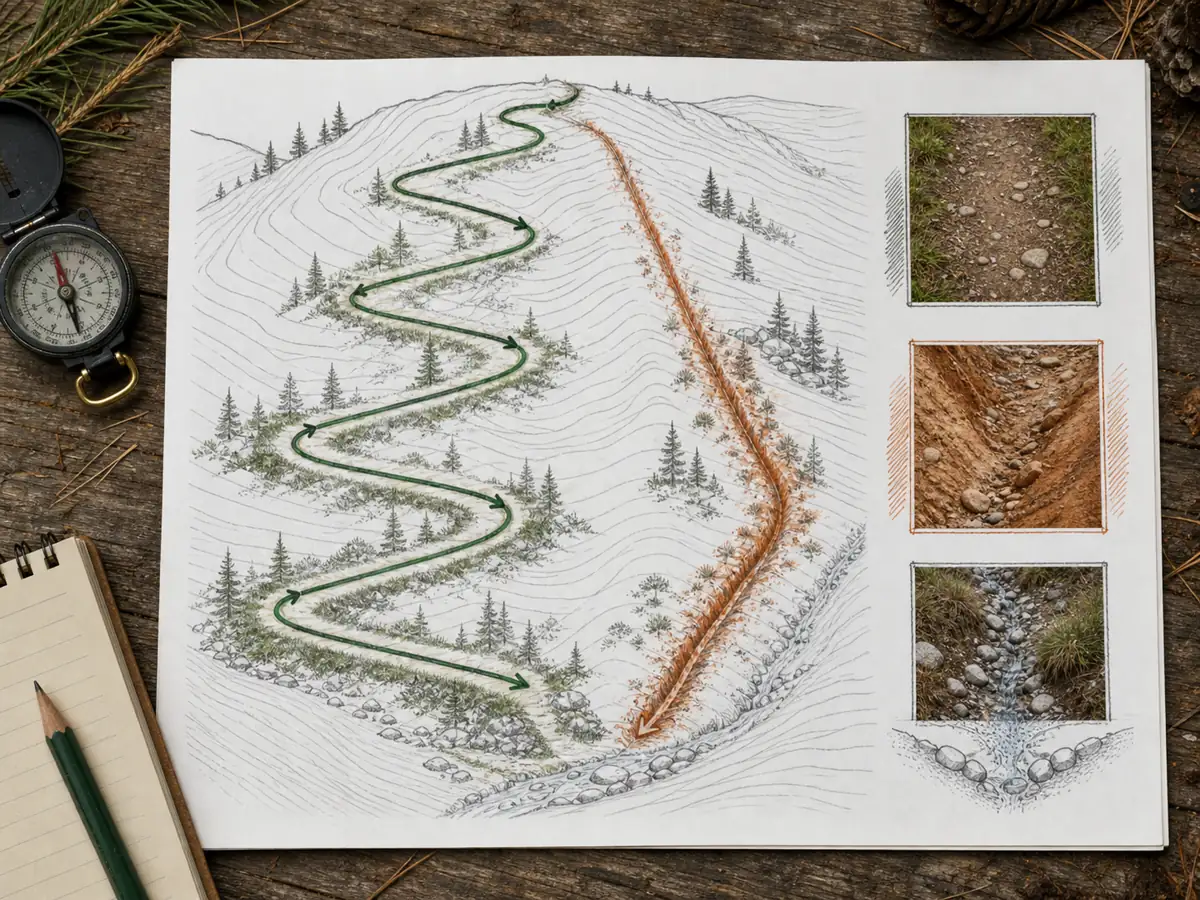
Route difficulty still depends on total climb, surface, exposure, weather, and the group's pace. A switchback makes a slope more manageable, but it does not make the trip easy.
Why does cutting a switchback cause damage?
Cutting means leaving the constructed turn and walking a shorter line between two levels of trail. Repeated feet remove plants and organic cover, loosen soil, and form a channel.
Rain and snowmelt then deepen that channel and carry sediment onto the maintained tread below.
The short cut can also confuse later hikers. Once a visible scar forms, people may treat it as the real route, creating parallel paths that require more repair.
Stay on the built line even when the corner looks slow.
- Read the treadFollow the worn, constructed route toward the full turn.
- Hold the inside lineDo not widen the corner to avoid a rough step or puddle.
- Complete the reversalStay on tread until the outgoing direction is clear.
- Resume your paceAccelerate only after footing and traffic are visible.
- Report damageSend the location of blocked drainage or a growing shortcut to the land manager.
The Forest Service states that cutting across switchbacks tramples plants and creates parallel paths that erode severely. Sequoia and Kings Canyon permit guidance also tells visitors not to short-cut trails to prevent erosion.
This behavior belongs with practical hiking etiquette, because one person's saved steps can create repair work and unstable footing for everyone behind them.
How should you move through a switchback safely?
Slow before the turn. The corner may hide hikers, runners, stock, bikes, loose rock, ice, or a damaged edge.
Keep enough control to stop inside the visible section of trail.
Stay on the tread and give the turn room. On a narrow trail, communicate before passing and follow the local yielding rules.
Do not step onto fragile vegetation just to maintain pace.
Enter slow and leave clear after you can see the outgoing trail.
In rain, snow, or ice, the outside edge and polished inside corner may be slick. Shorten your stride and place each foot before shifting weight.
Rain makes this worse, because wet-tread footing changes both grip and the damage a shortcut causes.
If a switchback is closed, blocked, or visibly failing, follow posted instructions. Do not invent a bypass across the slope.
Share the location with the managing agency when no safe established route remains.
How can you recognize a false shortcut?
A shortcut often runs steeply between two obvious levels of trail. It may be narrow, loose, root-exposed, or partly blocked with branches and rocks.
The maintained route usually continues toward a built turn with more consistent width and drainage.
Use the official map and signs when several lines compete. A scar that saves distance does not become the route because many people used it.
Choose maintained tread over momentum when the lines separate.
- Look for the full reversing turn shown by the established tread.
- Stay inside drainage features, barriers, and restoration work.
- Avoid widening the trail around mud, snow, or rough steps.
- Keep children, dogs, and group members on the same built route.
- Report a growing cut instead of blocking or rebuilding it yourself.
A painted blaze marker may confirm which tread is official.
A stone cairn may serve that job where paint and posts are unsuitable.
Is every sharp trail bend a switchback?
No. A bend may follow a creek, go around a boulder, or curve with a ridge without reversing the trail across a slope.
A true switchback changes the direction of travel enough to connect two traverses at different elevations. On a map, the line usually folds back toward the direction it came from.
The ground gives better proof than map shape alone. Look for a built turning surface, supported outer edge, drainage features, and an outgoing tread that continues across the slope.
A hairpin bend on a road can resemble a switchback from above. Trail users often use both words casually, but the important field question is whether the turn belongs to the maintained tread.
Do not assume every faint line between two bends is part of the route. A direct line may be an erosion scar, an animal path, or an old route under restoration.
Shape needs ground evidence before you choose a line.
What should you do at a damaged switchback?
Stay on the established route unless a closure, sign, or trail worker directs you elsewhere. A collapsed edge, blocked drain, fallen tree, or muddy turning platform does not give you permission to create a new path across the slope.
Stop before entering the damaged part and look for official markers. If the tread remains open, cross one person at a time and avoid loading a soft outer edge.
Turn back when the remaining tread cannot support a controlled step. Loose fill, active water flow, fresh cracks, or an undercut edge can mean the corner is still failing.
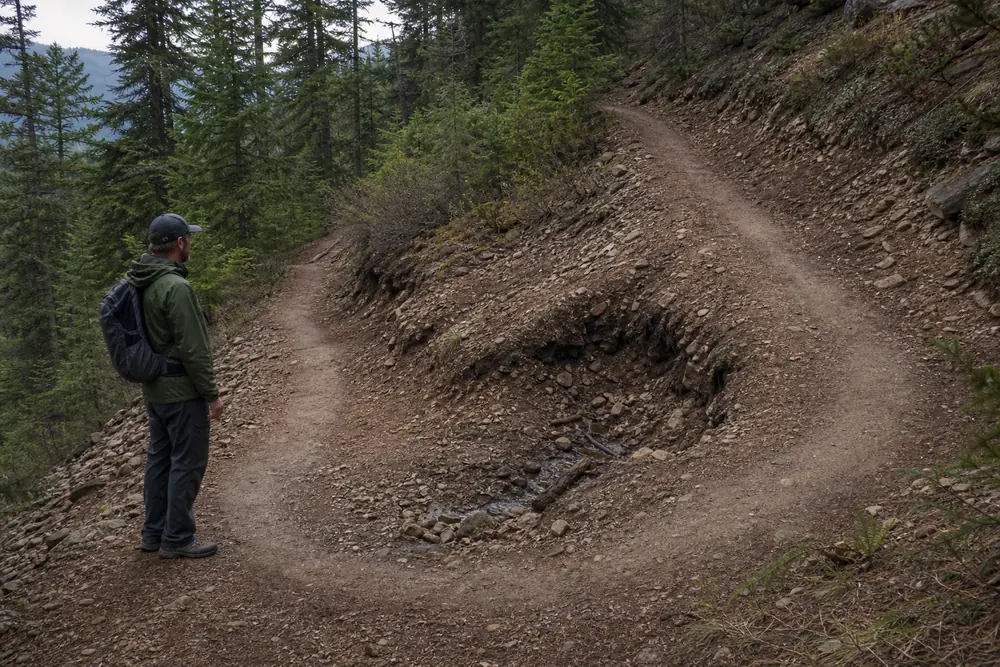
Do not kick rocks into place or move a drainage barrier. An improvised repair can redirect water, hide the real damage, or create unstable footing for the next person.
Report the trail name, direction of travel, nearest junction, and the type of damage. Coordinates and one wide photo can help the land manager locate the problem without guessing.
Describe what you saw instead of declaring the trail safe or closed. Current access decisions belong to the agency that manages the route.
A safe report beats a new scar when a turn needs repair.
Sources
The US Forest Service outdoor ethics guidance explains that switchback cuts trample plants and create parallel paths that erode severely. A Forest Service research report describes switchbacks as a way to limit erosion and conserve hiker energy.
Sequoia and Kings Canyon wilderness restrictions prohibit trail shortcuts to prevent erosion and protect vegetation.
AnswersQuestions readers ask
What is a switchback in hiking?
A switchback is a constructed trail turn that reverses direction across a slope so the route can gain or lose elevation over a more manageable grade.
Why do trails use switchbacks?
They spread elevation change over more distance, improve footing and drainage, reduce fall-line erosion, and make steep terrain easier to maintain.
Why should hikers not cut switchbacks?
Shortcuts remove plants and soil, create steep water channels, deposit sediment on the maintained trail, and encourage other hikers to follow a damaging false line.
How should I walk through a switchback?
Slow before the corner, stay on the full constructed tread, keep control around hidden traffic or loose footing, and resume pace after the outgoing trail is visible.